{2jtab: Movie Review}
|

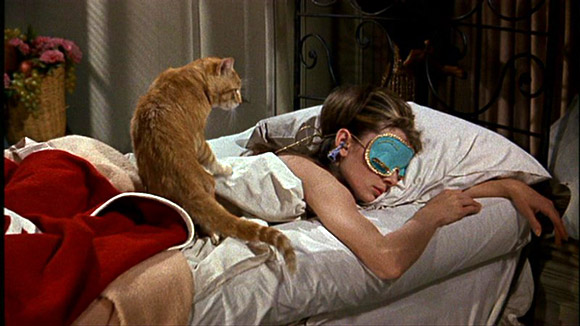
“There was once a very lovely, very frightened girl. She lived alone except for a nameless cat.”
For my money, the troubled world doesn’t get any better portrayed than with Blake Edwards’ Breakfast at Tiffany’s. Sure, it’s a departure from Truman Capote’s novella but the hard-hitting prose of Capote is replaced with the lyrical romance of composer Henry Mancini’s most memorable score and the effect – the merging of style and wit – is what makes Breakfast at Tiffany’s an iconic film. And then there’s the lovely and beautifully spirited Audrey Hepburn as Holly Golightly; extravert is her specialty. It wasn’t Hepburn’s, though. Whatever challenges she felt in her portrayal of one of the cinema’s finest heroines is masked by her grace and professionalism. Breakfast at Tiffany’s, arriving on blu-ray from Paramount Pictures this month, is the madcap masterpiece in writer/director Blake Edwards’ esteemed comedic career.
When Capote sold the rights to his novella, his intention was to have Holly Golightly played by Marilyn Monroe. Yet, the American scene of fashion was quickly evolving and so was the restless college underground who so welcomingly embraced Capote’s story. Monroe, as it turns out, was advised not to take the role. Re-written, Holly Golightly found her legs with Hepburn and, much to Capote’s disappointment, the world accepted it. Thus, Hepburn’s 60’s dominance, both in style and sweetness, was born.
Holly (Hepburn) is bright enough, but she gets everywhere with every one playing the part of the carefee ditz. To look at her, one would never know the loss of her illegitimate child or guess that she was running from a loveless marriage with "Doc" Golightly (Buddy Ebsen). She wants it that way; wants the world to forget that she was ever Lula Mae Barnes from Tulip, Texas. In Manhattan, gazing into the jewelry displays at Tiffany’s, she has found her home. Forget romance, forget flowers; momentarily pleasures are what she craves.
Understanding this (or not accepting it) makes things hard for Paul Varjak (George Peppard). From the moment he moves into the downstairs apartment, he finds himself drawn toward her carefree nature and afternoon guitar serenades; there is something different about this woman. Careful, Paul, don’t fall in love. Ironic though, since he himself earns his keep as an escort for a significantly older (and married) Emily Eustace Failenson (Patricia Neal). Makes things interesting, doesn’t it? Soon enough, Paul and Holly are on a crash course toward doom and destiny as all their secrets become unraveled and intertwined and then sealed on a rainy day in Manhattan.
There’s a bit of restless anarchy that runs throughout Breakfast at Tiffany’s that should be celebrated; it’s a sort of freedom that we don’t much get to witness on the screen these days from Hollywood. Witness the cocktail party and the calamity that ensues after the guests arrive and a woman’s hat is set afire by cigarette ash. Edwards eye for comedic what if possibilities is certainly a keen one and here, with what seems like 400 people in one tiny apartment, he delivers pure gold.
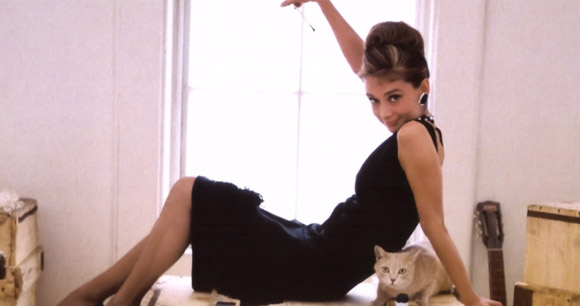
The breathtaking subtle beauty of the opening scene on the street of Manhattan with Hepburn dressed to the nines in her black Givenchy dress and holding her pastry, which Edwards has confessed was the hardest scene to shoot, is a mood establishing whopper where style and music crush into something that transcends time and becomes a statement; this is art. It’s a scene that I could deconstruct and analyze for hours. Fitting then, that Breakfast at Tiffany’s should become one of the most celebrated and revisited films by its fans. Even if roles like Sally Tomato (Alan Reed) and Mr. Yunioshi (Mickey Rooney) comes across as more cartoonish than they ought, George Axelrod’s adaptation is a loving tribute to a time and era when the world was about to explode. Boy, did it ever.
Which is why I respect Breakfast at Tiffany’s so much; this is the lead-in to big change across the America in the 60’s. While there is a certain degree of innocence to Holly Golightly, there’s a much darker reality that lurks beneath…and it’s the darker side that the film ultimately explores. It’s a hint at things to come from motion pictures in the 60s and for America, too.
{2jtab: Film Details}
 MPAA Rating: This titles has not been rated by the MPAA.
Director: Blake Edwards
Writer: George Axelrod
Cast: Audrey Hepburn; George Peppard; Patricia Neal; Buddy Ebsen; Mickey Rooney
Genre: Comedy | Classic | Drama
Tagline: Audrey Hepburn as Holly Golightly... the most hilarious heroine who ever rumpled the pages of a best-seller... is serving wild oats and wonderful fun!
Memorable Movie Quote: "Miss Gorightry!"
Distributor: Paramount Pictures
Theatrical Release Date: October 5, 1961
DVD/Blu-ray Release Date: September 20, 2011
Synopsis: The story of a young, jet-setting woman in New York City who meets a young man when he moves into her apartment building. He is being kept by a wealthy, older woman, but wants to be a writer. She is working as a high-priced escort and searching for a rich, older man to marry. The opening scene has her window-shopping at Tiffany's at six in the morning, after being up all night on a date.
{2jtab: Blu-ray Review}
|
||||||||||||||||||

Blu-ray Details:
50th Anniversary Edition
Available on Blu-ray - September 20, 2011
Screen Formats: 1.78:1
Subtitles: English, English SDH, French, Spanish, Portuguese
Audio: English: DTS-HD Master Audio 5.1; English: Dolby Digital Mono (Original); French: Dolby Digital Mono; Spanish: Dolby Digital Mono; Portuguese: Dolby Digital Mono
Discs: 50GB Blu-ray Disc; Single disc (1 BD)
The restoration process on the blu-ray is immaculate; gone are the crushing of colors that plagued the DVD and any other release of the film. The 1080p transfer is a celebration of all things color and style. Sharpness has been keyed in on and the clarity is first-rate; there is also a depth to classic scenes that has never before been revealed by previous releases. Skin tones are warm and clothing is brightly realized with fine details. Mancini’s snazzy score is in full swing with a lovingly perfect DTS-HD MA 5.1 lossless soundtrack that sparkles as much as Tiffany’s store window does now.
Supplements:
Commentary:
- Producer Richard Shepherd offers his unique knowledge about the history of Breakfast at Tiffany’s in the film’s only commentary. From the controversy of Asian stereotypes to the film’s location shooting, Shepherd is a relative oracle of knowledge; a fascinating listen for film buffs.
Special Features:
Of course, Mancini’s score has to be a forefront of these special features and what a feature it is. Mancini is made immortal in about 20 minutes. The supplemental material also attempts to reconstruct the famous cocktail party with its original guest (still living) and the group talks about the filming of the scene and all the on-set happenings. Some of the features have been ported over from the DVD release, including a fairly interesting making of special.
- A Golightly Gathering (21 min)
- Henry Mancini: More than Music (21 min)
- Mr. Yunioshi: An Asian Perspective (17 min)
- Breakfast at Tiffany's: The Making of a Classic (16 min)
- It's So Audrey! A Style Icon (8 min)
- Behind the Gates: The Tour (4 min)
- Brilliance in a Blue Box (6 min)
- Audrey's Letter to Tiffany (2 min)
- Galleries
- Theatrical Trailer
{2jtab: Trailer}
{/2jtabs}