{2jtab: Movie Review}
|

From the opening few comical seconds of Paramount’s Rango, it is evident that its primary source of inspiration has its roots in the iconic spaghetti westerns that Sergio Leone once made. The water-drained deserts, the hot as hellfire sun, the dirt-caked costumes, and the strange (and strangely archetypical) characters, even the mythic feel of those films are captured by this animated feature. Certainly other films have spoofed these classic films before (Kelly’s Heroes and Back to the Future III to name a very few), yet none have done it with such class, such characterization, and such love for the genre as Rango’s director, Gore Verbinski, has sun-kissed this film with.
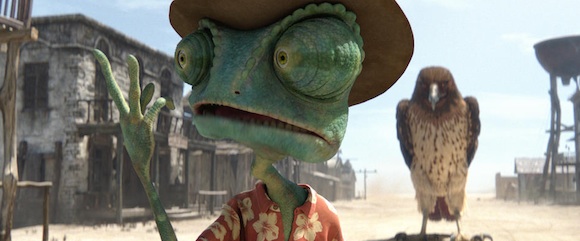
One glimpse at the film’s advertisements will get you fiendishly hooked into the mescaline-fueled world of Rango. Voiced by Johnny Depp (in a fantastic and lively performance that recalls the brilliance of Mel Blanc), Rango is a performer of sorts. Trapped inside his aquarium, he’s the director, the star, and the writer of his own chameleon productions. Days on end, he stars alongside the nude torso of a Barbie doll, a wind-up toy fish, and a poolside location. It’s enough to drive any pet insane – until the day he gets thrown from a moving vehicle (in a spectacular barrage of animation and impact) and has to travel outside the comforts of his own cage to wander the desert land – in search of a town called Dirt - just outside of Las Vegas.
As hinted at by a wise, but lone possum named Roadkill (Alfred Molina) - in full conquistador regalia ala The Man from La Mancha – the search for Dirt, especially in the desert, will be a dangerous one, but it will provide our hero’s eventual release. The characters he meets in the town of Dirt – an iguana named Beans (Isla Fischer), a squirrel named Doc (Stephen Root), and a Gila monster named Bad Bart (Ray Winstone) to name a few - are as different as rugged and individual puzzle pieces, but they all crave one thing – water – and there’s one old desert animal, Tortoise John (Ned Beatty), who knows exactly where it is, who controls it, and just how badly everyone wants it.
Figuring out just how to play the starring role as the town’s new sheriff, Rango must pretend to be someone he isn’t, never has been, and probably never will be, in order to gain the town’s respect and bring order over the chronic disorder – ranging from deadly aerial hawk attacks and predatory visits from Rattlesnake Jake (Bill Nighy) - the town’s residents are used to. Yet, the creature they must fear the most is already living among them – the coveter of the water. Rango just has to figure out who it is before it is too late to be the hero of his own story.
Copping the conflict (and the certain look of a character) from the pages of the Chinatown script is a massive and bodacious risk, yet screenwriter John Logan makes it work with the inspired Looney Tune aspect and drug-fueled frenzy he bubbles to the forefront of the film. Froth it isn’t. Yeah, Rango has heart, but the escapades and character-driven arcs are what really matters to the beats of this work of art.
There’s a limitless appeal and direction in interpreting the events in the film, which will be fun to hear and puzzle over for months to come, too. Like the best of the genre, this isn’t a simple children’s movie that you can see once. Repeated viewings are a must. Yes, one can safely skim the surface and never go any deeper with the levels and layers of the narrative, but to stay floating upon the surface is such a disservice to this acid trip.
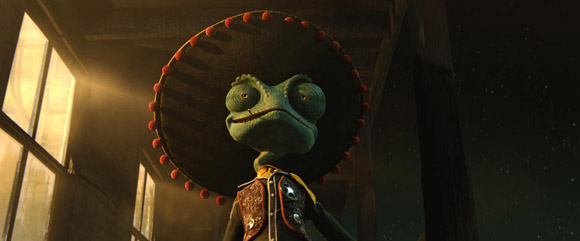
At times, the darkness of the script eats at the “animated” aspects and reveals the very raw nature of Rango’s changing stripes. He’s confused, alone, and not even sure who he is as a transplanted creature of the desert. He may be serenaded by a group of mariachi owls at every turn – who narrate his story in amusing and socially disturbing (always hilarious) ways – but Rango is one lizard that is certainly on his own. Not even the Eastwood-inspired mythical Spirit of the West (voiced by Timothy Olyphant) can solve this chameleon’s problems of identity and, at his most needed moment, speeds away in a golf cart loaded with Oscars.
When Rango is at his most depressed, he takes a risky and supremely suicidal stroll across a busy highway at night and is suddenly in the blazing white sands that funneled Captain Jack Sparrow’s mind-trip in Pirates of the Caribbean: At World’s End. Yes, the connection is there and it is supremely explored – making the bizarreness of Davy Jones’ Locker more than just a general note of weirdness in one film. This seems to be Verbinski and Depp’s commonality; a meeting of the strangest of minds, if you will. In fact, I will go so far as to suggest that almost every weird note in the Pirates of the Caribbean trilogy is referenced and enhanced by the exploits of Rango.
Rango is high-spirited, funny, and genuinely inspired from beginning to end, making this film the best non-Disney, non-Pixar film to ever be released. In fact, with its clever nods to Clint Eastwood, Hunter S. Thompson, True Grit and Chinatown, Verbinski’s Rango just might be the best animated film I have ever seen.
{pgomakase}
{2jtab: Film Details}
 MPAA Rating: PG for rude humor, language, action and smoking.
Director: Gore Verbinski
Writer: John Logan
Cast: Johnny Depp; Isla Fisher; Abigail Breslin; Ned Beatty
Genre: Comedy | Famil | Animated
Memorable Movie Quote: "Believe in that there sign. For as long as it hangs there we've got hope."
Tagline: Rango
Distributor: Paramount Pictures
Official Site: www.rangomovie.com
Release Date: March 4, 2011
Blu-ray Release Date: July 15, 2011
Plot Synopsis: From the director of “The Pirates of the Caribbean” comes RANGO, featuring Johnny Depp in an original animated comedy-adventure that takes moviegoers for a hilarious and heartfelt walk in the Wild West. The story follows the comical, transformative journey of Rango (Depp), a sheltered chameleon living as an ordinary family pet, while facing a major identity crisis. After all, how high can you aim when your whole purpose in life is to blend in? When Rango accidentally winds up in the gritty, gun-slinging town of Dirt – a lawless outpost populated by the desert’s most wily and whimsical creatures – the less-than-courageous lizard suddenly finds he stands out. Welcomed as the last hope the town has been waiting for, new Sheriff Rango is forced to play his new role to the hilt . . . until, in a blaze of action-packed situations and encounters with outrageous characters, Rango starts to become the hero he once only pretended to be. With a cast that includes Depp, Isla Fisher, Abigail Breslin, Alfred Molina, Bill Nighy, Harry Dean Stanton, Ray Winstone and Timothy Olyphant as the Spirit of the West, Rango is an exciting new twist on the classic Western legend of the outsider who saves a town – and himself in the process.
{pgomakase}
{2jtab: Blu-ray/DVD Review}
|
||||||||||||||||||

Blu-ray Details:
Available on Blu-ray - July 15, 2011
Screen Formats: 2.40:1
Subtitles: English; English SDH; French; Spanish; Portuguese
Audio: English: DTS-HD Master Audio 5.1; French: Dolby Digital 5.1; Spanish: Dolby Digital 5.1; Portuguese: Dolby Digital 5.1
Discs: 50GB Blu-ray Disc; Two-disc set (1 BD, 1 DVD); Digital copy (on disc); DVD copy; Bonus View (PiP)
Playback: Region A, B
Paramount's 1080p transfer of Rango is superb. Sharper than it appeared in theatres across the nation, this HD transfer is plump with color, detail, and texture. With a wonderful palette of vibrant color, this digitally-animated movie is a grand masterpiece of High Definition. Every frame, whether is be the dusty brown of land or the brightest of blues for the sky, is a rich texture of delight. Paramount has outdone themselves with the picture on this one, folks. The DTS-HD MA 5.1 lossless soundtrack is not as sharp as the picture but how could it be? It blisters with noise and it thumps with the best of them using the full dynamic range of its sound stage with positive results.
Supplements:
Commentary:
- If viewing the Extended Edition, the commentary can be accessed. It’s a decent enough conversation about the technical look and making of the film from director Gore Verbinski, Head of Story James Ward Byrkit, Production Designer Mark McCreery, Animation Director Hal Hickel, and Visual Effects Supervisor Tim Alexander. It’s detailed and provides insight into how animated films are made.
Special Features:
Finally, a blu-ray with supplemental material that doesn’t completely suck by sticking to a paint-by-numbers formula. Here we have a great look at the making of the film from almost every angle; hand-drawn stills to voice-acting to actual performances from the actors. It’s intriguing and informative and never repetitive. The disc also comes with deleted scenes and picture-in-picture storyboards. Great material for a great movie.
The Special Features are entertaining, light-hearted and simply fun. They are as follows:
- Breaking the Rules: Making Animation History (50 min)
- 10 Deleted Scenes with an alternative ending (8 min)
- Real Creatures of Dirt (23 min)
- Storyboard Reel Picture-in-Picture
- A Field Trip to Dirt
- Theatrical Trailer
{2jtab: Trailer}
{pgomakase}
{/2jtabs}