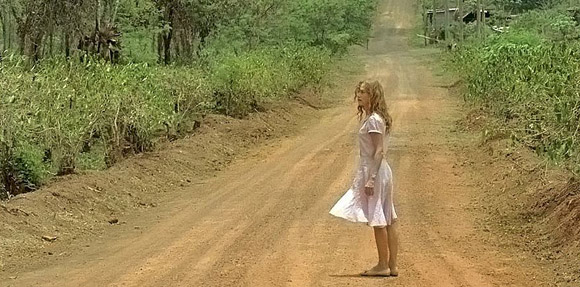

In her 1988 debut film, Chocolat, French filmmaker Claire Denis visited colonized Africa, telling her story of childhood memories with a strong visual affinity for the landscapes and people of the beautiful continent. With White Material, she dips back into that same familiar bag of themes, only this time she tinges the haunting story with elements of danger, defiance, and audacious stubbornness.
At the center of the character-driven story is Maria Vial (Isabelle Huppert), a white Frenchwoman running a coffee plantation in an unnamed African country falling into crisis due to political strife and impending civil war. The French army, as well as her fellow colonists, have all but completely pulled out, leaving the hard-driven woman to scrape up whatever labor she can for one final coffee harvest. Roving bands of machete-wielding bandits and teenaged thugs roam the countryside extorting tolls and protection fees, but Maria considers this her home and shirks off the advice from friends and authorities who say she should pack up and leave. Meanwhile, a rebel leader known as The Boxer (Isaach De Bankole) has holed himself up on Maria’s plantation.
Maria is a petite, wiry wisp of a woman not to be taken lightly. We don’t know much about her - how she ended up there, where she gets her drive, or why she refuses to leave. But we see that for some reason, she’s determined to go about the task of tending her plantation as if nothing has changed. Like Scarlett O’Hara, she’d just as soon scrape at the sun-parched ground with her bare hands, than give in to the impending civil strife beating a bloody path to her door.
Denis’s purposeful evasiveness on the matter of her main character’s demeanor and motivations is initially a bit frustrating. As moviegoers, we’re programmed to find something that might allow us to identify with a sympathetic character. But there’s just not much there. As the film plots its deadly course, we soon begin to realize that Maria’s denial of the severity of the situation is reflective of our own sense of being and awareness of place. For her to leave would surely mean an even more certain death than staying put. Is this really what Denis is saying with Maria’s unyielding opacity, or has the filmmaker just recklessly abandoned her main character, leaving us to fend for ourselves in a sea of moral ambiguity? Getting the answer likely lies in whether or not you find engagement from other parts of the film.
Belgiam-born cinematographer Yves Cape (Humanité) beautifully saturates the film in the striking Africa environment – sometimes plush, at other times hardscrabble. Though we’re not directly told where the plot takes place, we can piece together from several references to child soldiers, coffee and never-ending civil war that it’s most likely a mash-up of several western Africa countries like Sierra Leone and Cameroon. The camera mostly captures Maria from the rear or side, rarely allowing us to search the woman’s face for insight into her soul. An ambient Stuart Staples score creates a fitting accompaniment to the beautiful French-language film. The film's beautiful camera work alone is nearly enough to lift it above its other numerous shortcomings. Nearly.
The movie’s name poetically refers to artifacts of white privilege left behind in colonized Africa - items such as a gold-plated cigarette lighter playfully coveted by one of the country’s child rebels. While we get the idea Denis knows what she’s doing with the metaphor of racial recompense in her movie – having grown up in colonial Africa and explored the idea in prior films - whether or not she “gets” the idea of fleshy, full-bodied characters grounded in a sense of viewer compassion is still up in the air. And in a character-driven piece of art, that’s not necessarily a good thing.
 MPAA Rating: This film has not been rated by the MPAA.
Director: Claire Denis
Writer: Claire Denis and Marie N'Diaye
Cast: Isabelle Huppert; Christopher Lambert; Isaach De Bankolé; Nicolas Duvauchelle
Memorable Movie Quote: "I'm offering you work. The coffee needs picking."
Distributor: IFC Films
Official Site: whitematerial-lefilm.com
Release Date: January 14, 2011 (USA theatrical limited)
Blu-ray Release Date: No details available
Plot Synopsis: The regular army is preparing to reestablish order in the country. To clean up. To eliminate the rebel officer also known as The Boxer and rid the countryside of roving child soldiers.
All the expatriates have gone home, getting out before things turn nasty. Of the Vials - coffee planters who have lived here for two generations - Maria stands firm. She’s not about to give in to rumors or abandon her harvest at the first sound of gunfire.
Just like her father-in-law and her ex-husband who is also the father of her son (a little too much of a slacker in her opinion) she is convinced that Cherif, mayor of the neighboring town, will protect them. If she asks him, he will save the plantation. He has a personal guard, a private militia of tough guys, heavily armed and well trained.